
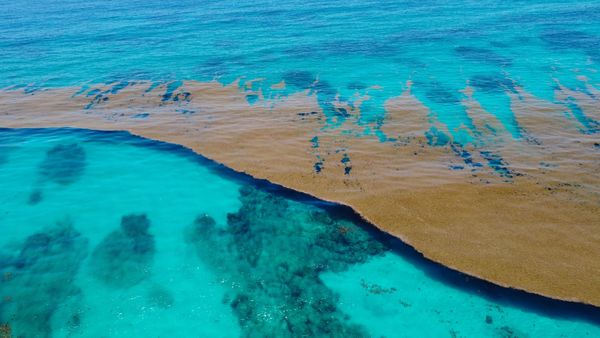
Record Sargassum blooms are rotting on Caribbean coasts, harming tourism and ecosystems, while drought and costly nitrogen fertiliser strain farms. Funded by contracts with hotels, governments and coastal projects, SargaCycle harvests Sargassum at sea to make crop-protecting products for global use.
Since 2011, Sargassum blooms have hit Caribbean coasts every year, growing at around 16% a year to a record 37.5 million tonnes in 2025. Ashore, the seaweed rots within days, releasing toxic gases, damaging reefs and driving away tourists, with clean-up costing the region nearly US$210 million in 2021 alone. Farming faces its own crisis. Three-quarters of harvested cropland has suffered drought-related yield losses, while farmers depend on synthetic nitrogen fertiliser made from natural gas, leaving them exposed to volatile prices and uncertain supply. Urea prices rose 53.7% in one month in March 2026. SargaCycle, a British-based company, solves both. Hotels, governments and coastal projects pay us to remove Sargassum at sea, funding a low-cost raw material. We turn it into a proprietary biostimulant that helps crops withstand drought, heat and salinity, aiming to cut reliance on nitrogen fertiliser, with bioplastics, biogas and biochar in development. Achievements: presented at CHOGM 2026 as one of Antigua and Barbuda's national investment-ready projects, our biostimulant has been independently tested by a third-party with significantly positive results, heavy-metal removal validated with Cambridge and Imperial College London technology and three months of sea trials in Antigua.