
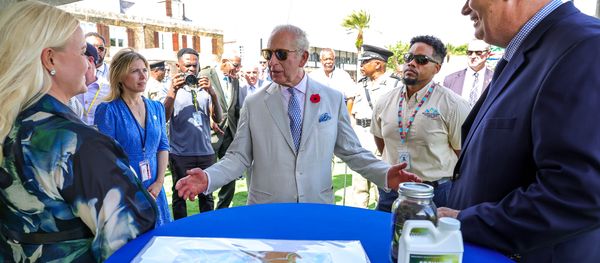
King Charles III joins Commonwealth leaders and Sustainable Markets Initiative to tackle Caribbean sargassum seaweed crisis
His Majesty King Charles III, Founder of the Sustainable Markets Initiative (SMI), today attended the Sargassum Showcase, hosted by the SMI at the English Harbour, Antigua and Barbuda, during the 28th Commonwealth Heads of Government Meeting (CHOGM 2026).
Sargassum is a seaweed that has become one of the Caribbean's most pressing environmental and economic challenges, as vast influxes threaten coastal communities
Scientists have linked the expansion of Sargassum to a combination of changing ocean conditions, nutrient availability, shifting ocean currents and climate-related factors.
The SMI has responded to a request from leaders across the Caribbean to use its unique convening power to mobilise the private-sector and advance a roadmap for collective action by government, tourism, finance, development and technology firms
At the Sargassum Showcase at CHOGM 2026, His Majesty King Charles III joined Commonwealth leaders, SMI and representatives from the sargassum ecosystem to view new technology, models and solutions designed to tackle the growing problem
Tuesday 3 November 2026, St John’s, Antigua and Barbuda / London: His Majesty King Charles III, Founder of the Sustainable Markets Initiative (SMI), today attended the Sargassum Showcase, hosted by the SMI at the English Harbour, Antigua and Barbuda, during the 28th Commonwealth Heads of Government Meeting (CHOGM 2026).
Sargassum is a naturally occurring floating seaweed that has become one of the Caribbean's most pressing environmental and economic challenges. Once an important part of the Atlantic marine ecosystem, unprecedented quantities are now washing ashore across the Caribbean, threatening tourism, fisheries, coastal communities and marine biodiversity.
While Sargassum provides valuable habitats for marine life when floating offshore, the problem arises when enormous quantities accumulate along coastlines.
As the seaweed decomposes, it can release hydrogen sulphide gas, creating unpleasant odours and potentially harmful air quality. Thick accumulations can also damage coastal ecosystems, obstruct fishing activities and make beaches unusable.
Scientists have linked the expansion of Sargassum to a combination of changing ocean conditions, nutrient availability, shifting ocean currents and climate-related factors. The issue is particularly acute for Caribbean small island developing states (SIDS), where tourism, fisheries and healthy coastal ecosystems are critical to their economies
What is being done
While significant effort has historically focused on emergency beach clean-up and environmental management, the challenge has been bringing together fragmented initiatives and pilots towards a more coordinated, investable and commercially scalable regional response across the Caribbean.
The SMI has responded to a request from leaders across the Caribbean to use its unique convening power to mobilize the private sector by bringing together tourism and hospitality operators, sargassum collection and processing businesses, technology companies, investors and financial institutions, researchers and government partners.
The SMI has engaged a breadth of organizations across the sargassum ecosystem, including the Government of Antigua and Barbuda, the Antigua and Barbuda National Parks Authority, Grupo Puntacana, Cox Enterprises, Kestrel Shipping, Algas Organics, SarGas Limited, Seaweed Greens, SargaCycle, Rum & Sargassum Inc., Akumal Abierto, AQL and the University of the West Indies.
Over the past six months, the SMI has built a network spanning the Caribbean, North America, Europe and beyond, mapped technologies and commercial applications across the value chain, and developed a pipeline of high-potential opportunities for the Terra Carta Exchange, a collection of the world's most ambitious sustainability projects that progress the mission of the SMI’s Terra Carta and Astra Carta.
The initiative has established a growing network of stakeholders, identified priority projects and opportunities for investment, and laid the groundwork for a coordinated regional approach capable of accelerating innovation, investment and implementation across the Caribbean.
Sargassum Showcase at CHOGM 2026
At the CHOGM 2026 SMI Sargassum Showcase, His Majesty King Charles viewed interactive and 3D models, saw heat maps of Commonwealth countries most at risk and heard from company representatives (including Seaweed Greens, SargaCyle, SarGas Limited, Rum and Sargassum Inc, Grupo Puntacana, aql holdings, Kestrel Liner Agencies and the University of the West Indies) who gave detailed explanations of their new technologies.
The Sargassum Showcase was also attended by representatives and officials, including:
· Jennifer Jordan-Saifi, President and Global Envoy of the SMI
· Mrs Anne-Marie Martin, the National Parks Commissioner
· Ms. Desley Gardner, Deputy Heritage Manager of the National Parks Authority
· Mr. Ruleo Camacho, Marine Biologist, National Parks Authority
· The Hon. H. Charles Fernandez, Minister of Tourism, Civil Aviation, Transportation and Investment
· The Hon. Michael Joseph, Minister of Health, Wellness, Environment & Civil Service Affairs
The Sargassum Showcase at CHOGM 2026 has provided an important focal point for this work, creating a platform to elevate sargassum as a regional resilience, sustainability and economic development opportunity.
Jennifer Jordan-Saifi, President and Global Envoy of the Sustainable Markets Initiative, said: "Sargassum has too often been treated as a problem to be simply swept off the beach. Today, with the support of His Majesty King Charles III, we have shown that it can be the foundation of new Caribbean industries, jobs and investment. By bringing governments, tourism operators, innovators and investors around one regional roadmap, the SMI is helping to build a pipeline of investable sargassum projects – demonstrating the kind of partnership CHOGM 2026 was designed to accelerate."
Billy Lambeth, Co-Founder and Chief Operating Officer, SargaCycle, said: "The scale of the challenge is unprecedented. The Great Atlantic Sargassum Belt reached a record of around 37.5 million tonnes in 2025, and 2026 has been the second-largest year on record. SargaCycle’s mission is simple: stop decomposition and stop landfill. We intercept Sargassum at sea, before it reaches the shore, then refine it through a proven scientific process to meet international market standards.
For governments, it supports the regulation, policy and practices needed to end decomposition and landfill, both essential to restoring island tourism and ecology. For hotels, it offers recovery from Sargassum damage through a management strategy with a clear, direct return on investment.
Further down the chain, our agricultural products give farms worldwide affordable solutions to soil stress. Because we operate across the whole value chain, we can be far more cost-effective, and we pass those savings on to farmers. Two global problems, solved from one common nuisance. What the region now needs is shared collection infrastructure and long-term offtake agreements, so that a seasonal, unpredictable resource can become a bankable supply chain.”
Camilla Webster, CEO and Co-Founder of Seaweed Greens, said: “Seaweed Greens is building the infrastructure for a commercial sargassum industry: purpose-built collection boats, processing plants and integrated management systems for resorts and island governments. We have secured investment, received boat orders for island markets and developed our processing technology through four factory iterations. Independent testing has validated our arsenic-removal results, while sales of our soil amendments demonstrate a paying market for processed sargassum. We are bringing engineering, manufacturing and structured finance together to deliver systems that can be replicated across the Caribbean and wider Commonwealth.
“His Majesty’s vision in ‘Harmony’ helped inspire our determination to make a circular sargassum economy work at industrial scale. That requires reliable infrastructure, customers for the resulting products and commercially viable business models. Through strategic partnerships and the Sustainable Markets Initiative’s convening power, we see an opportunity to accelerate investment and delivery, building local processing capacity, skilled employment and new sources of revenue for coastal economies.”